

What is Marketplace Optimization?

What is Marketplace Optimization?
Lighthouse Commerce Solutions is a Wisconsin based consultancy specializing in SEO, AIO, e-Commerce growth, and social media marketing. We achieve success through the leveraging of AI technology and usage of cutting edge tools while filling it with real-life human context. This translates to long term success in the ever changing online landscape.
Setting The Stage
The e-commerce space is ever changing and new ways to do business online are being introduced at breakneck speed. You might wonder “how can I compete?’ as you get bombarded by technological changes that seem to come daily. In this blog entry, we want to help ease those worries by introducing you to marketplace optimization. The core essence of marketplace optimization is that it’s an aspect of the overall e-commerce growth strategies and draws upon many aspects we have covered in other blogs. As we begin to dive into how business sells across multiple marketplaces such as Shopify, Amazon, Etsy, eBay, and more, we want to give you key insights as to how you can improve visibility, conversion, and revenue.
What does Marketplace Optimization Mean?
What is Marketplace Optimization?
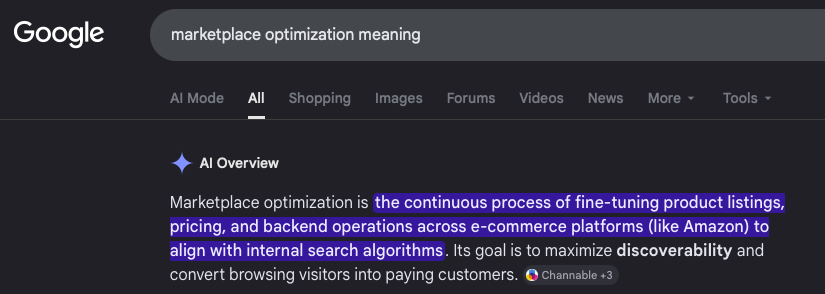
If you were to do a simple Google search, on what marketplace optimization is, this is what you will be served: The continuous process of fine-tuning product listings, pricing, and backend operations across e-commerce platforms (like Amazon) to align with internal search algorithms. Its goal is to maximize discoverability and convert browsing visitors into paying customers. All in all, it seems quite straight forward but what would the “optimization” aspect to this be and why is it important? The reason is simple, it is to keep your products or listings up to date and within the current cultural relevance found through AIO and SEO. There are indeed “evergreen” ways to set up your listings but to truly get the most out of the platform you are investing in, you need to take product listing optimization seriously as a means to success. A good example of an evergreen aspect to a listing would be its branding and history. These are aspects that are fundamental to the product’s identity and gives strong signals to a potential customer. This can stay more or less the same, thus the term evergreen. For other aspects, such as listing titles, descriptions, related content, images, and more, these can be dynamic and lend themselves well to optimization by looking into what is relevant surrounding them. Through good SEO and AIO (AI Optimization) we can keep our “finger on the pulse” and maximize relevant search information around each listing. For more context, feel free to catch up on our blogs about SEO and AIO (AI Optimization). We also created an easy guide with 7 tips on how to optimize your product listings. You can learn more about that HERE.
Benefits of Marketplace Optimization
With a good definition of marketplace optimization in mind, now would be a good time to talk about the benefits of it. The first is increased visibility. Through the usage of marketplace SEO we can learn what potential buys are looking for on various platforms. This allows us to not only successfully rank in Google but also effectively on the platforms you are using. When we have higher visibility, it can lead to higher conversion rates which is the next benefit. Effective online marketplace management can lead to higher conversions because it allow you to put your products into the eyes of the masses and a good product always speaks for itself. A good product will lead to stronger customer trust which is the best form of advertising. These benefits are only a few of the many that comes with proper marketplace strategies, best of all, they all work together. Each aspect mentioned here works together in a circular fashion and with good implementation, feed into each other for continued success.
Identifying the Core Building Blocks
The building blocks that allow you to construct an effective post starts with good keyword research. Through this, we can identify what different customers are looking for in regard to your product’s listing. Once we have identified the keywords we want to target, we will begin optimizing the product’s listing itself. This can be achieved by studying the competition, running proactive AB testing, or even referencing previous successful posts made in the past. Good visuals go a long way, fill your product page with rich, interesting content. Use both pictures and videos to illustrate the product and lean into how your product differs from the competition. Do not shy away from the strengths or uniqueness of your product, this gives it personality and identity. In our Top 10 Ways to Boost Social Media Marketing blog entry, we talked about advertising and it’s ok to allocate a budget for ads. The same can be said here. Good planning and budgeting for advertisement allows you to maximize each platform’s strengths to your advantage. Platforms such as Amazon have incredible user bases and leveraging its advertising system puts you in the eyes of more potential buyers. If you are using a separate platform that is more independent, like Shopify, good customer experience is absolutely essential. Good UI and UX is a key aspect to good SEO rankings and if you are operating an independent store, a clean customer experience is paramount for success. Every factor from menus, to navigation, to links all play a part! As we move into the final building blocks, we need to ensure we have a clear picture on our inventory management and pricing strategy. Inventory management can sometimes be an easy to overlook factor in many marketplace strategies. Being passive in your inventory management by allowing the platform to notify you to out of stock or low stock products can lead to loss of business. Active inventory management such as understanding restocking lead times, sell through on respective products, and compiling an ever evolving product priority list is extremely important when executing our e-commerce growth strategy. Finally, a good price. Apple’s former VP for Marketing Phill Schiller always mention “engineering a good price” into their products and its a key phrase that works to great effect. Setting a good price by creating a margin formula allows for you to simply plug and play various numbers to see what works for said product. This also allows you to run very competitive research on other brands or similar products to gauge what makes the most sense when it comes to pricing. A good structure then lends itself well to promotions too, it allows you to easily plan out what percentages you want to lower at a glance.
Common Mistakes
To have a better understanding of our building blocks, we must also highlight some common mistakes. Many of these mistakes are the opposite of what we mentioned above and to start, we shall begin with poor listings. Poor listings can often be attributed to small mistakes which can lead to loss of business. Simple things like poor spelling, bad grammar, repetitive word usage or overly complicated explanations all play into poor listing. Not using well researched keywords or only using industry terms specifically relating to a product is also examples of poor listing. Outside of using well researched keywords, we want to use broad language and easy to understand terms for a wider audience to find your listed product or service. This is especially important when posting on a platform like Amazon. This does not mean shy away from more specific terms, but rather use them correctly in ways that are well thought out. Inconsistent branding and weak imagery are also contributing factors that can lead to loss. Weak product descriptions are usually a common mistake many people make that could lead to inconsistency with branding. Always follow a “Who, What, and How” formula when writing descriptions, this allows your listing to stay on point and always provide a clear brand image to whomever is reading it. Weak imagery also applies to any video content too. If there is desire to create video content along with any photos, low production value will negatively affect the listing. Rounding out the final two points about common mistakes are a lack of performance monitoring and neglecting customer feedback. In an earlier paragraph, we talked about always monitoring your inventory and in relation to this, your sales performance. Through good inventory management and performance analysis you can paint a better picture as to what is moving and what is not. Your product listing optimization also plays a huge part into this factor because with good listings you have deeper insights from bigger data sets. Finally, pay attention to customer feedback. Take the time and try to understand how a customer feels and make a conscious effort to see if it’s at all feasible to implement the changes. It never hurts to listen and to ignore suggestions completely will definitely work against you.
Can AI Play a Role?
In previous blog entires we talked extensively about AI and its role within the modern e-commerce optimization space. Within marketplace optimization, AI also has a role to play. The role best fit for it in our marketplace strategy is going to be for workflow and how we should streamline it by off loading time intensive processes. A good example is using AI to assist with generating content. It’s never a good idea to simply prompt an AI then upload whatever it spits out but rather use AI to give you good content ideas like mood boards for photos or storyboards for videos. AI is also a great assistant in keyword research. A great way to leverage artificial intelligence is using it as a tool to fill your baseline research ideas which will then allow you to add deeper human context to it. AI can miss emotional cues or interests that might resonate deeply with various groups of potential customers. In addition, AI can be used for predictive analysis which can help businesses paint a better picture of their product’s performance. There are many more aspects to how AI can help a business, you can learn more about AIO HERE.
Is your Business Ready?
There are a few questions we should always keep on the top of our minds when considering our online marketplace management, here are some that can be helpful. Are sales declining? This is a very obvious one but if not picked up upon sooner, it could feel quite sudden. The signs of declining sales can show up very early if we know where to look. These signs could be a drop in visitor traffic, a dip in social media engagement, or even changes in buying behaviors. Another question is “are we experiencing low conversion rates”. This feeds into the previous question about declining sales. There are always signs, in this case, regarding low conversion rates, we should look into our product listing optimization. Are the listings in line with what the audience or potential customers looking or searching for? Losing visibility is another important questions we must be asking as well. A good way to determine this, is to ask “how is our marketplace advertising coming along?”. Going back to a previous segment from this blog, we mentioned leveraging the advertising aspects of Amazon. This gives you great analytic insights for your listing. Through this, we can have a better idea as to why or how visibility is being lowered. Finally, are we or have we expanded into new marketplaces? When using large e-commerce marketplaces such as Amazon, Etsy, or e-Bay it can be wise to not put all of your eggs in one basket but rather look into which platform plays best with which type of product. Are we investing time listing products on the right one to fully leverage it? This is an important question when deciding which platform to use.
Conclusion
Marketplace optimization is an ongoing, active process that requires hands on effort to get the most out of each platform you decided to invest in. In today’s online e-commerce space, we cannot afford to be passive players hoping to hit it big with one or two products. We have the tools and building blocks for great e-commerce growth strategies and through laying a good foundation, understanding marketplace SEO, and leveraging of AI we can begin to achieve success. We at Lighthouse Commerce Solutions offer comprehensive marketplace consulting services to help you maximize each platform. By scheduling a free consultation, we can begin our marketplace optimization journey together or if you would like to learn more, check out our blogs HERE. Marketplace Optimization is a core service of our. To learn more about our processes and offerings, please click HERE.
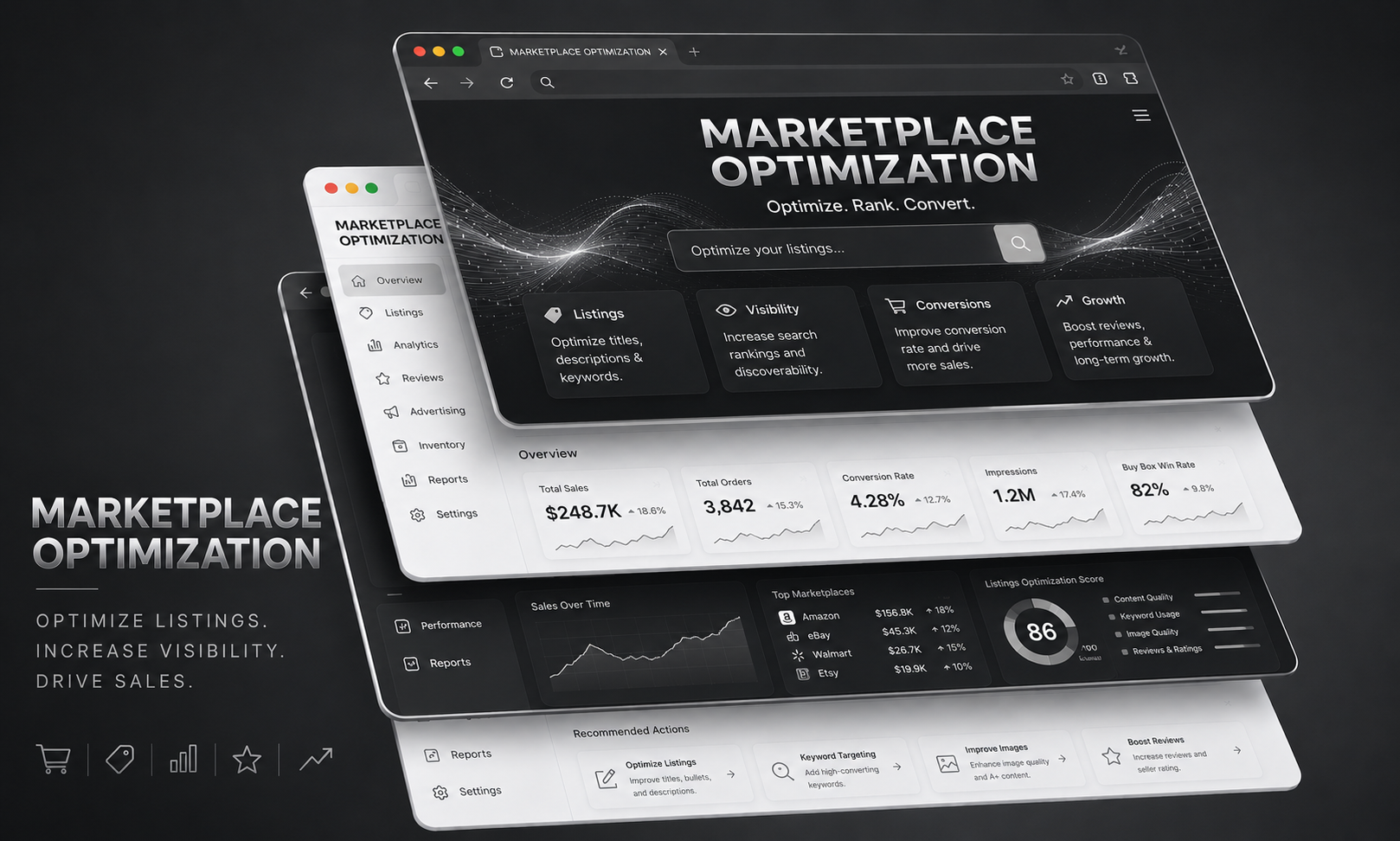
Marketplace Optimization is a core service offered by Lighthouse Commerce Solutions. Please reach out to learn more.
