
7 Best Ways to Boost Product Listings

7 Tips to Boost Product Listings
Lighthouse Commerce Solutions is a Wisconsin based consultancy specializing in SEO, AIO, e-Commerce growth, and social media marketing. We achieve success through the leveraging of AI technology and usage of cutting edge tools while filling it with real-life human context. This translates to long term success in the ever changing online landscape.
The Art of the Product Listing
When most people think about starting an online store, we often emphasize on aspects like navigation, page layouts, or menus. However, when we are getting our stores ready, optimizing product listings are often a forgotten but essential building block of success. Its easy to make common mistakes when creating listings such as: Using very industry specific terms, not referencing SEO data, using convoluted or unclear language, or using a one-size-fits-all approach for various marketplaces. There is an art to product listing and through product listing optimization, your products and services can be found easier by a wider range of customers. In this blog, we want to help you learn this art with these 7 product listing optimization tips!
Write a Clear, Descriptive Product Title
For step one, we must begin by signaling to a potential customer exactly what they are looking at. A clear and descriptive product title should be easy to understand yet eye catching. A key to remember is to always try and craft your titles for an average customer. This means you want to use simple to understand language. With easier to understand language, it makes incorporating relevant search terms feel more natural. A good title should also clearly identify what the product is by putting the most important product information first. An example of this could be “Premium Quality Italian Leather Winter Jacket” instead of “Conceria Tempesti Winter Jacket”. The example here is to illustrate the impotence of simple, yet clear language while using search terms that are more broad for a wider range of customer. The search volume for “Premium Quality Italian Leather” is going to be higher than a more specific term like “Conceria Tempesti”. There is a place to incorporate these more specific terms, in the description, but as a title, keeping things clear will win out. There are other aspects that can improve upon this as well when crafting an overall strategy that relates to marketplace optimization. Along with product title optimization, menus and navigation can help with your SEO as well. To have a better understanding about this, please read our blog about Marketplace Optimization HERE.
2. Use Search Terms That Matter to Your Marketplace
It’s important to never assume that Google keywords are the same as ones used in different marketplaces. When we are optimizing for an online e-commerce website we do research that pertains to SEO as it ranks with Google or relevant AI models through AI optimization. However, when we are listing on different platforms such as Amazon, Etsy, eBay, or even Walmart, we research different keywords, patterns, and behaviors. “Premium Quality Italian Leather” might work on one platform while “Conceria Tempesti” might work better on another. To properly optimize your listings for each platform, product keyword research needs to be handled thoroughly and with an eye for the desired platform. Always remember to review listing performance and keep listings fresh because this will allow you to take full advantage of the ever changing data found by using the right tools for the job. On various marketplaces such as Etsy, it’s also important to understand how they want listings to be structured. In this instance, Etsy prefers a varied multi-word phrase as the title. This means if you want to optimize for them, take into consideration different synonyms or how to incorporate language that can drive buyer intent. “Premium Quality Conceria Tempesti Italian Leather Vintage Evening Winter Jacket”. This is a clean example of a varied, multi-word phrase that gives a buyer intent.
3. Incorporate SEO Data
In our third step, we want to piggyback on the previous point in step two. Always leverage SEO when creating a title, description, attributes, tags and other appropriate fields. Search data is available for a reason and to leverage these data sets are absolutely essential in how to improve product listings. A layered approach is always the best when tackling new listings. Look at each product listing as its own entity, take time to find relevant search data and prioritize how to deploy it on page by order of volume. Always keep in mind, only using high volume search terms or keywords doesn’t mean it will drive clicks to your page and the same is also true in the opposite, simply because there is lower search traffic doesn’t mean it won’t drive clicks. The best practice for your listings will always be to never sacrifice readability for keywords. Ultimately, you are creating a product or service for a human not algorithm, the description and listings should in turn drive human interests. SEO plays a crucial role in modern business, see how it can help yours in our blog about How Can SEO Help My Business.
4. Create High Quality Product Media
Step four is media, media, media! Creating high quality media is absolutely essential for a good product listing. When it comes to how we list products, no matter on our own or other e-commerce platforms, we need to have a shift in mind set when it comes to how we are presenting our products online. Customers and potential buyers are looking for clean, crisp photos that properly show the product as their key image. Photography is becoming an increasingly important aspect of business and marketing, simply using a cell phone to snap pictures for a quick upload will drastically lower the quality of your listing. Good quality product photography should show a sense of scale and size, different angles, and should convey a message to your buyer. Where possible, use lifestyle imagery, static product photos are great but potential buyers want to imagine using or wearing said product. In the example of this Italian leather jacket, it should be modeled nicely or shown off with good composition and lighting to make it appealing. An added benefit is video. If you are listing a product that can be assembled, having an installation guide would greatly increase the quality of your product listing. Getting the clicks are only half the battle the end goal is to create something that drives buying intent. Finally, good media is a crucial aspect to a social media marketing strategy. The product photos and various media should translate from one medium to another. Seeing a high quality social media post comes with the expectation that the product will be of equal quality, the last thing you want is to have a high quality post lead to a low quality listing. We have a more in-depth blog about Social Media Marketing HERE.
5. Research your Competitors
Here at step five is an easy to overlook aspect when preparing your marketplace strategy. Competitor research is an essential part to making sure you are identifying top performing listings as it acts like a gauge to see if you are within the market average to ensure your listings are competitive. Compare titles, keywords, images, pricing, descriptions, and more. This is a great way to give yourself or your team a check when optimizing each listing. When we are hyper focused on a task at hand, we can often find ourselves “in our own world”. This bad habit will eventually lead to blind spots that cause gaps in our listings. The key here is to not “copy” your competitor but understand what they are doing and be able to learn from their processes. Applying successful methods are a sure way in how to improve product listing visibility.
6. Focus on the Buyer, not only the Algorithm
Step six, let’s make sure our posts are designed for people and not machines. Throughout this whole blog, we have been talking about keywords and various ways to use SEO throughout our listings to ensure we are optimizing for search. With this in mind, we need to always remember that ultimately we need to convey a message to a real person on the other side of screen. Some helpful tips are to remember to communicate clearly by using simple to understand language. Another helpful tip is to find ways to answer common questions within your description while conveying benefits to a potential buyer. Finally, take time to understand your product, brand, and mission statement before doing keyword research for product listing SEO. Understanding the emotion and goals behind the brand allows you to craft briefs and write insightful listings that convey a sense of humanity that appeals to real people. Always optimize for people when deploying your SEO strategy, this is the golden rule!
7. Measure, Test & Improve
Step number seven, always test, measure, and improve. Product listing optimization is an ever evolving process that requires constant work and monitoring. It is best practice to always monitor your impressions and visibility. In our blog about how SEO can help your business, we talk about the various signs your business needs SEO, a drop in visibility and site traffic is a sure sign. The same can be applied here, always keep an eye on the analytics. A great way to start your process of measuring and testing is to set aside a designated time each day to focus on analyzing search term performance while comparing it with sales review performance. These numbers offer great insight as it shines a light on where you are doing well and where work needs to be applied.
Let’s Wrap This Up!
Product listing optimization is key to long term e-commerce success and essential to marketplace optimization. No matter if you are operating an online store or leveraging the various platforms to sell on, these 7 steps are going to be your best bet for getting your products seen. We at Lighthouse Commerce Solutions have a wide range of tools and methods designed to help you with marketplace optimization and different ways to get ranked. We offer a free first consultation, let’s see how our services can best serve your needs, feel free to book yours today. For more information about our core Marketplace Optimization services, click HERE to visit our Marketplace Optimization page.
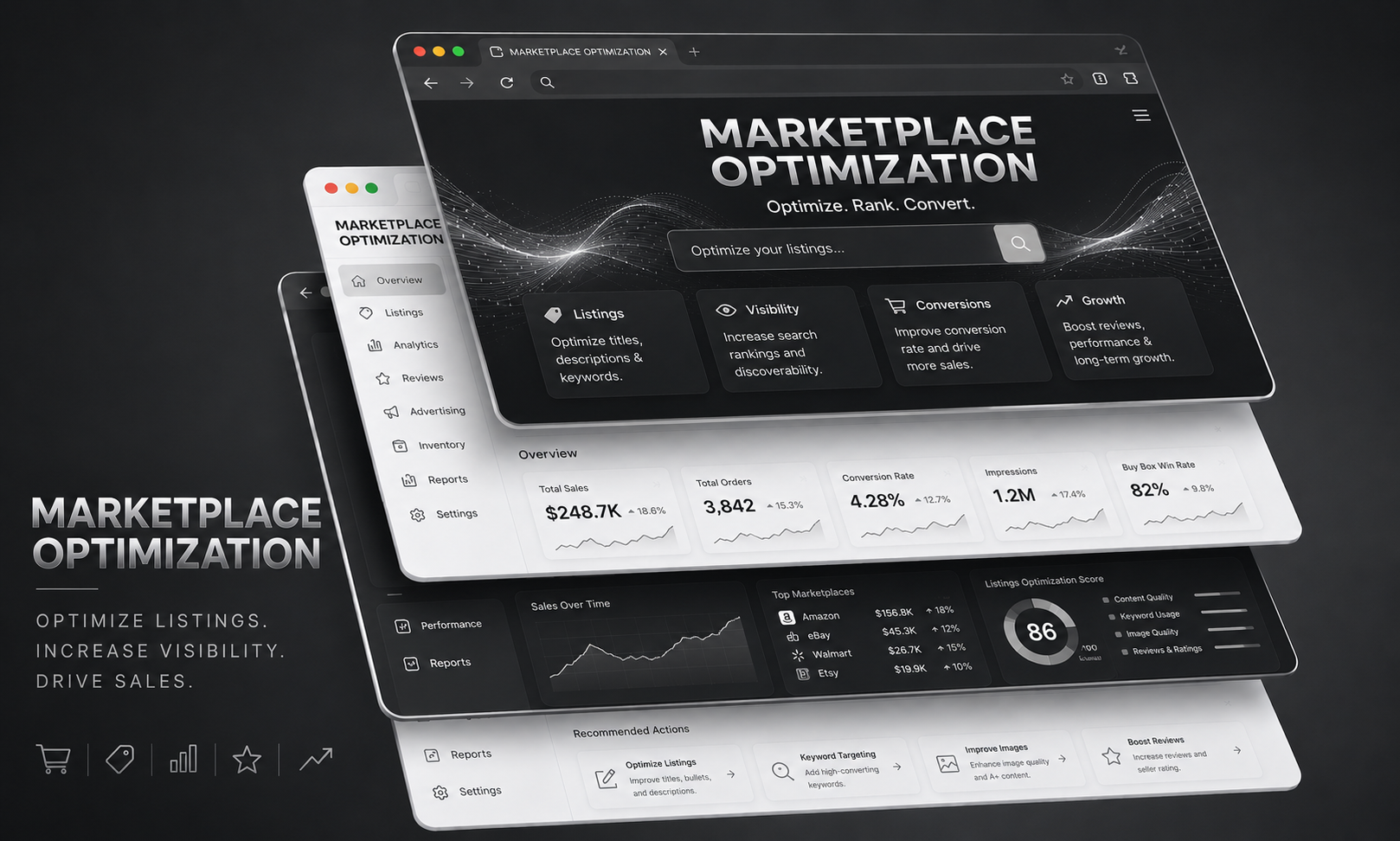
Marketplace Optimization is a core service offered by Lighthouse Commerce Solutions. Please reach out to learn more.
